City Desk
The Wabash depot is still the town’s front door
Moved, rebuilt, and dedicated in December 2012, it is the last combination depot on the old Toledo–St. Louis line.
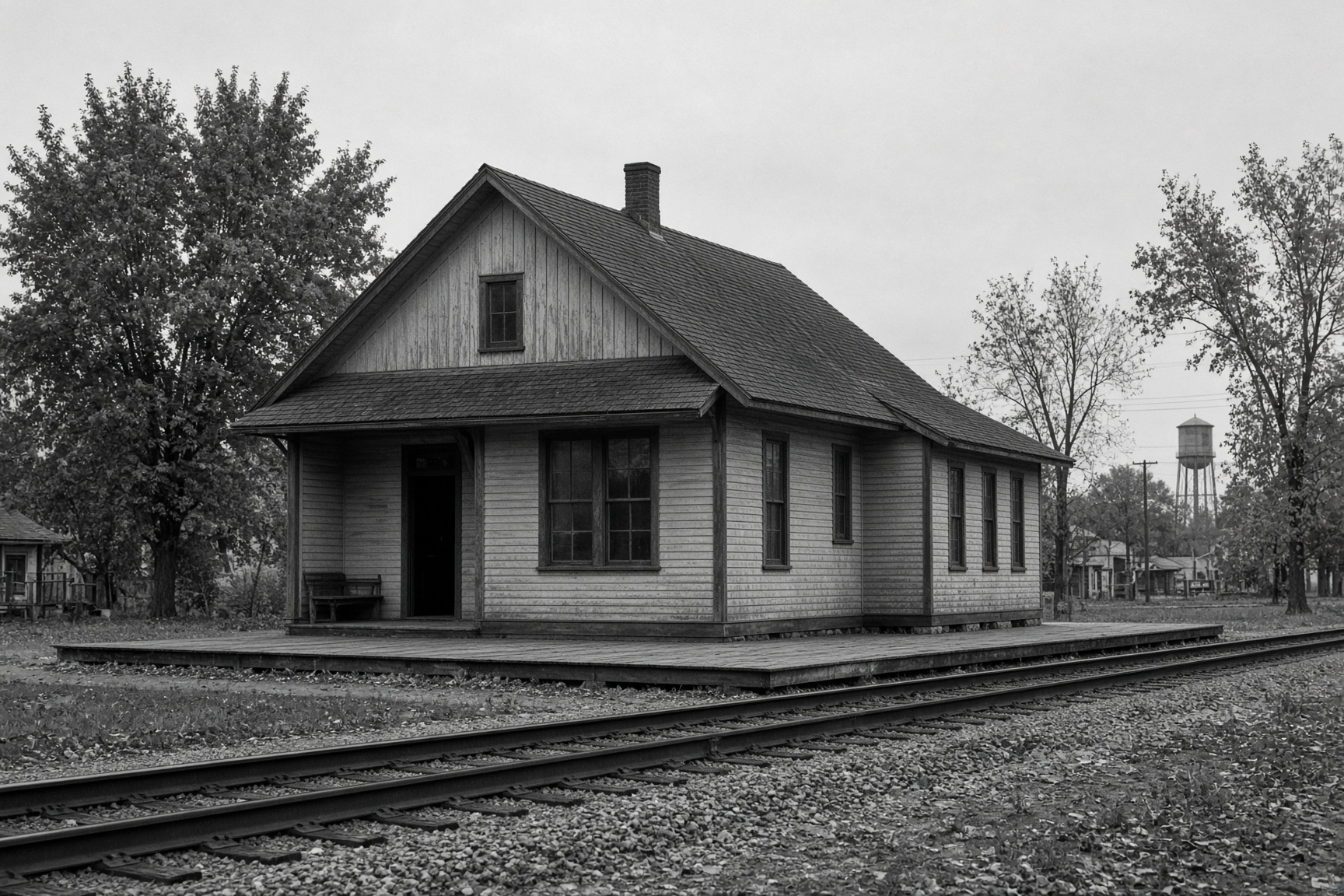
The Wabash reached New Haven a generation before the Nickel Plate and left behind a combination depot, passengers on one end and freight on the other. It is the only such building to survive on the Wabash Toledo–St. Louis line, now Norfolk Southern, and it is listed on the National Register of Historic Places.
Local volunteers moved it, restored it, and dedicated the work in December 2012. The building is no longer an accident of a railroad timetable. It is a decision. A town that lets its depot go has decided to be a driveway between somewhere and somewhere else.
A town that lets its depot go has decided to be a driveway.
The Nickel Plate kept its own stations: one on the southeast side of the tracks at State Street when the line opened in 1882, and a later one on the southeast side at Broadway. The watchman came before the automatic signal. The hotel at 531 State Street came in 1920, on the northeast side of the tracks, because passengers needed a bed that understood the timetable.
Stand at the restored Wabash depot and the lesson is plain. New Haven was a canal town that refused to die when the canal was drained. It became a railroad town, and it has declined, so far, to become only a memory of one.